ModuSystems AI is the free Engineering Decision Engine for modular motion. Describe a task — pipetting plates, dispensing adhesive, tending pallets — and it sizes the motors on real torque curves, checks the safety gates, builds the 3D model, picks the controller and returns a priced, validated system in seconds. Built on ModuSystems' LYNX actuators, AXYS controls, and engineered systems.
Most "AI configurators" pick a part number. ModuSystems AI runs deterministic sizing math — the same calculations a motion engineer does by hand — against the real product catalog, and prints every number it used. Torque at the actual shaft speed is read from the motor's measured curve, not from holding torque. Three gates must pass before a system is approved: at least 25% torque margin at speed, reflected-inertia mismatch no greater than 10:1, and a catalog load rating of at least twice the payload. When a build fails a gate, the engine fixes it or says so — it never hands you a part that doesn't work.
Stepper sizing uses NT pull-out curves at 24 V; servo sizing uses NV BLADE continuous curves at 48 V. Every motor in the frame is swept and the sweep is shown — the smallest motor that passes wins.
≥ 25% torque margin at speed. ≤ 10:1 inertia mismatch. Catalog rating ≥ 2× payload. A build that fails any gate is marked not approved, with the number that failed.
Inertia mismatch or a rating shortfall? The engine fits a 3:1 or 5:1 gearbox, or steps the whole system up a frame size (45 → 60 → 90) — never a mixed-family build.
Ask for both and get both columns from the same spec: margin, mismatch, speed headroom, cycle rate and the price difference per axis. When stepper can't do it, the servo answer is already there.
Gravity torque is included for lifts and Z axes, the holding and brake requirement is stated, lead-screw vs. belt guidance is given, and Z lead and top-speed sweeps answer "how fast can Z go?"
The controller is named as real BLC modules (a six-axis gantry is three BLC-2T) with spare axes counted. If the catalog can't meet the spec, you get the gap in one sentence and an engineer within one business day — not a wrong part.
Short, unscripted sizings on the production engine. New episodes on the Two-Minute Motion playlist.
XX'YZ gantry, 1.75 kg, 500 × 500 × 100 mm: the family sweep, the 2× rating gate, and why the engine won't mix frame sizes.
One single-axis spec, both motor types on real torque curves: margin, mismatch, speed headroom, price per axis — and the honest verdict.
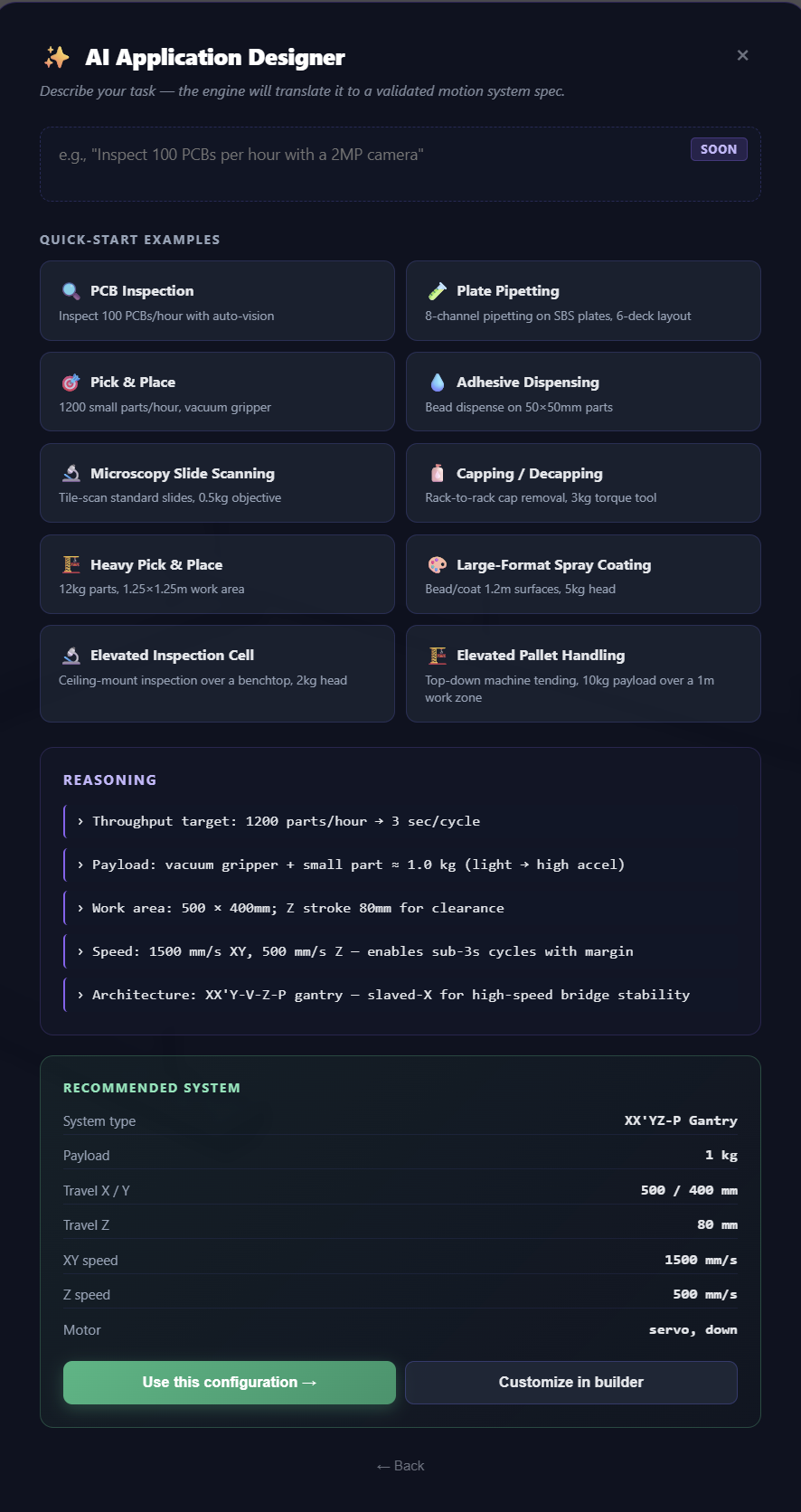
The AI Application Designer turns a one-line task description — pipetting plates, dispensing adhesive, scanning slides, tending pallets — into a complete, ready-to-build motion spec with reasoning you can audit.
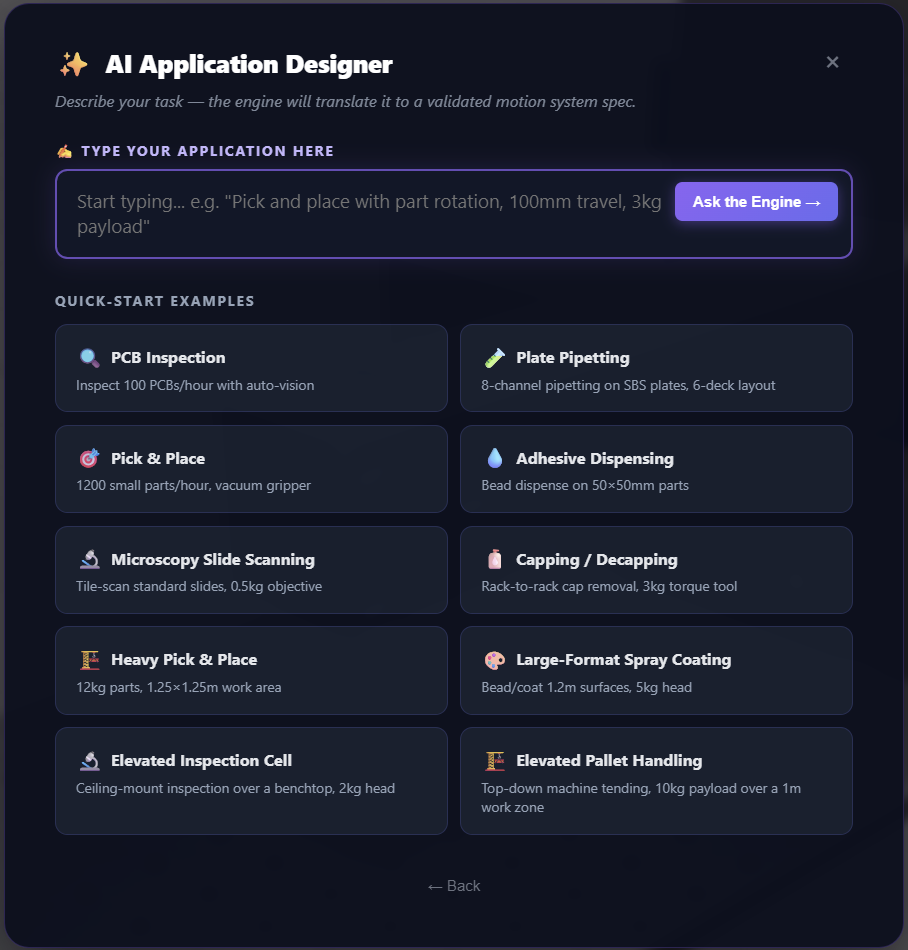
Not mockups. Not renderings. These are live screenshots from the production platform.
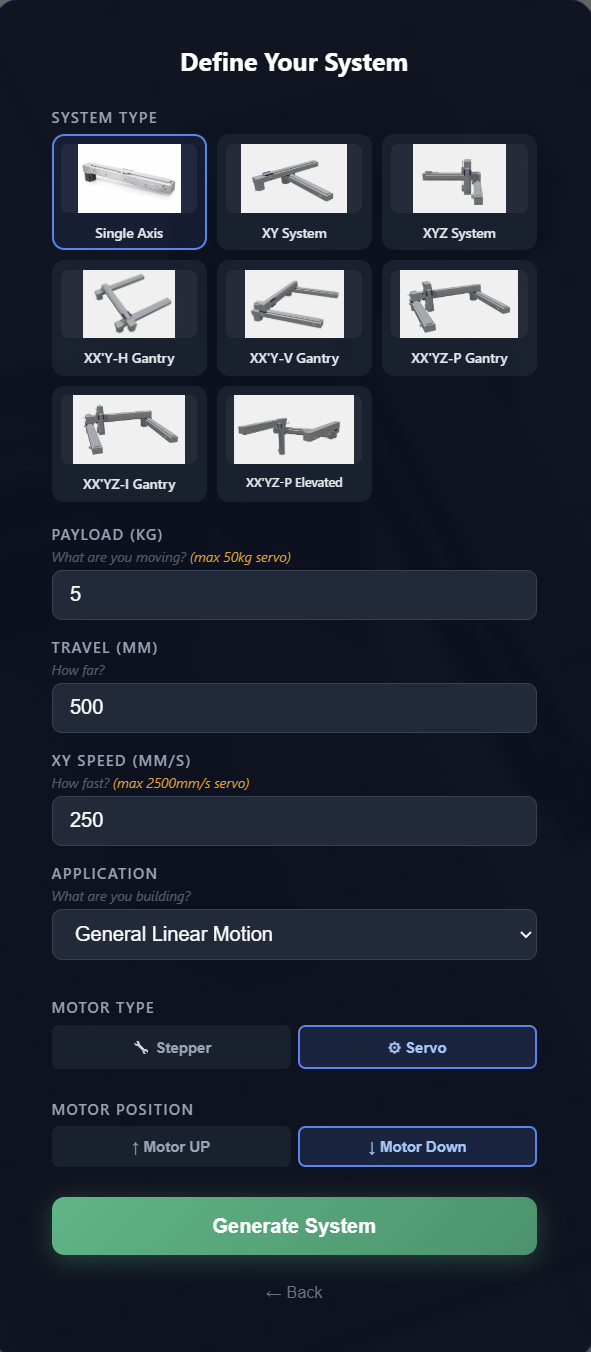
Select a system type — single axis through 6-axis gantry — enter payload, travel, and speed. The engine auto-selects actuators, sizes gearboxes, matches controllers, and validates safety margins.
Eight system configurations with visual selection. Stepper or servo. Motor up or motor down. One click to generate.
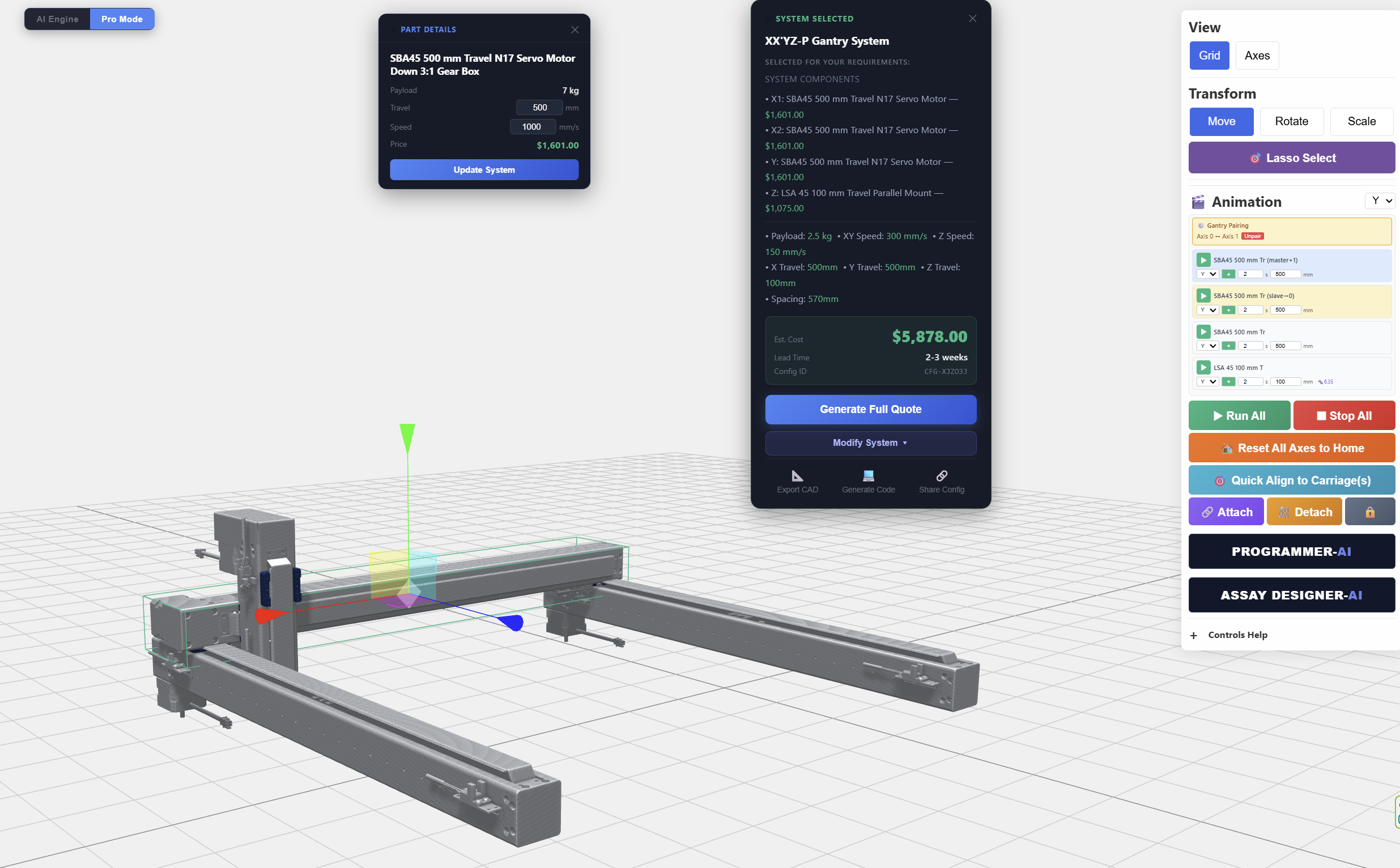
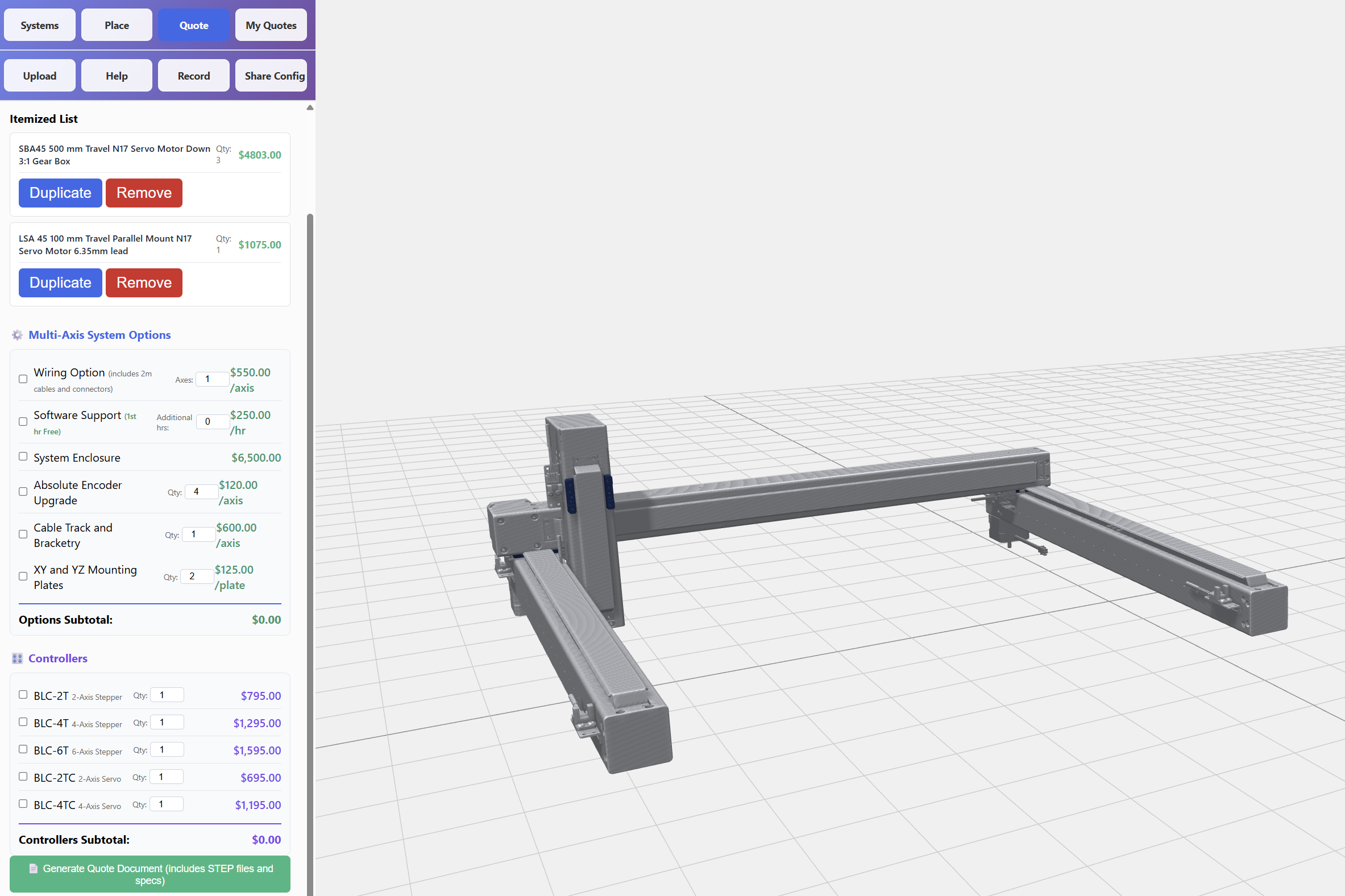
Full WebGL 3D viewport with orbit, pan, and zoom. Systems assemble automatically — carriages mount to carriages, bridges connect axes, Z-axes attach in parallel or inline configurations.
Click any component for part details, specs, and live pricing. Modify travel, swap actuators, or reconfigure the entire system without starting over.
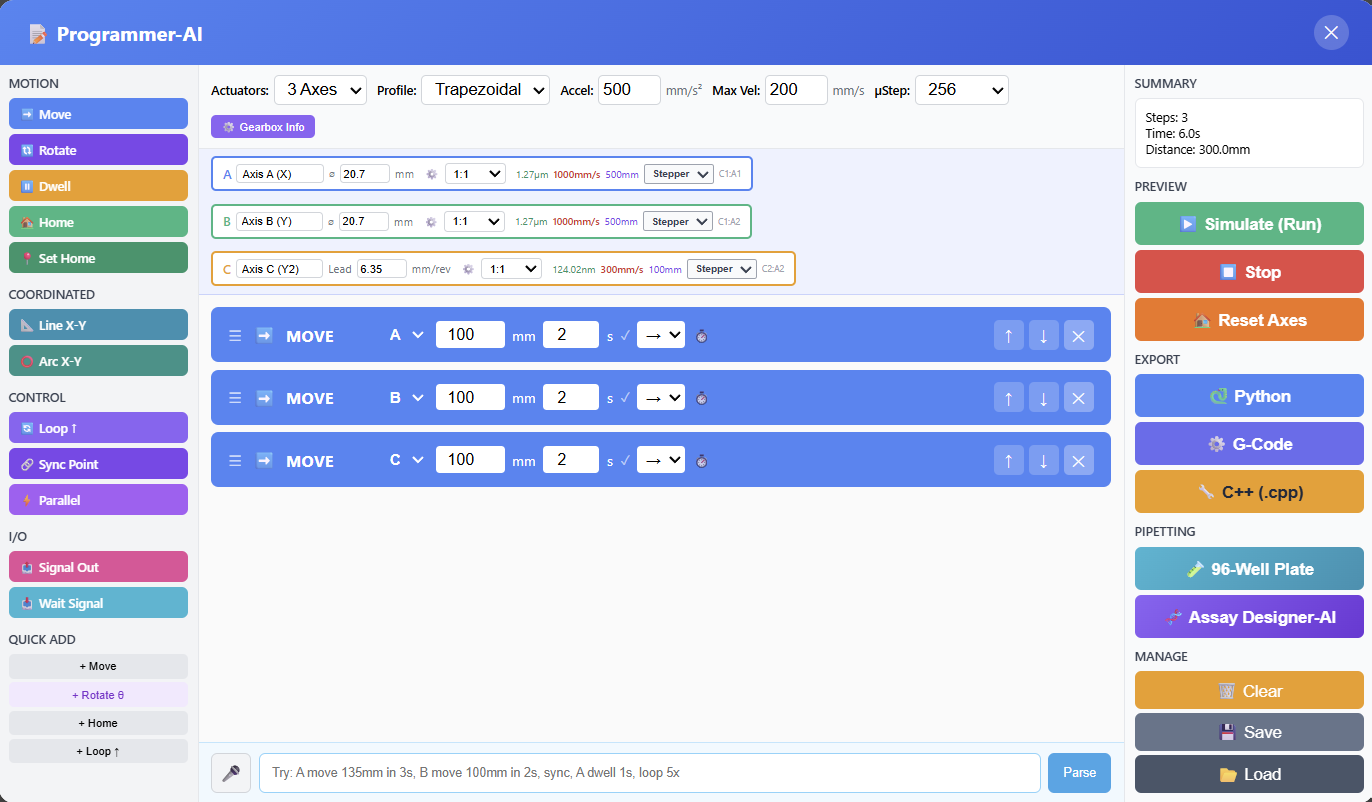
Drag-and-drop sequence editor for multi-axis motion programming. Define moves, dwells, loops, sync points, and parallel operations. Set acceleration profiles, velocities, and microstepping.
Run the simulation live in the 3D viewport. Export as Python, G-Code, or C++ for direct controller integration. Includes pipetting and assay design tools for life science applications.
Real-time pricing updates as you build. Full bill of materials with part numbers, product images, spec sheets, STEP file downloads, and brochure links. Multi-axis system options, controller selection, and cable management — all itemized.
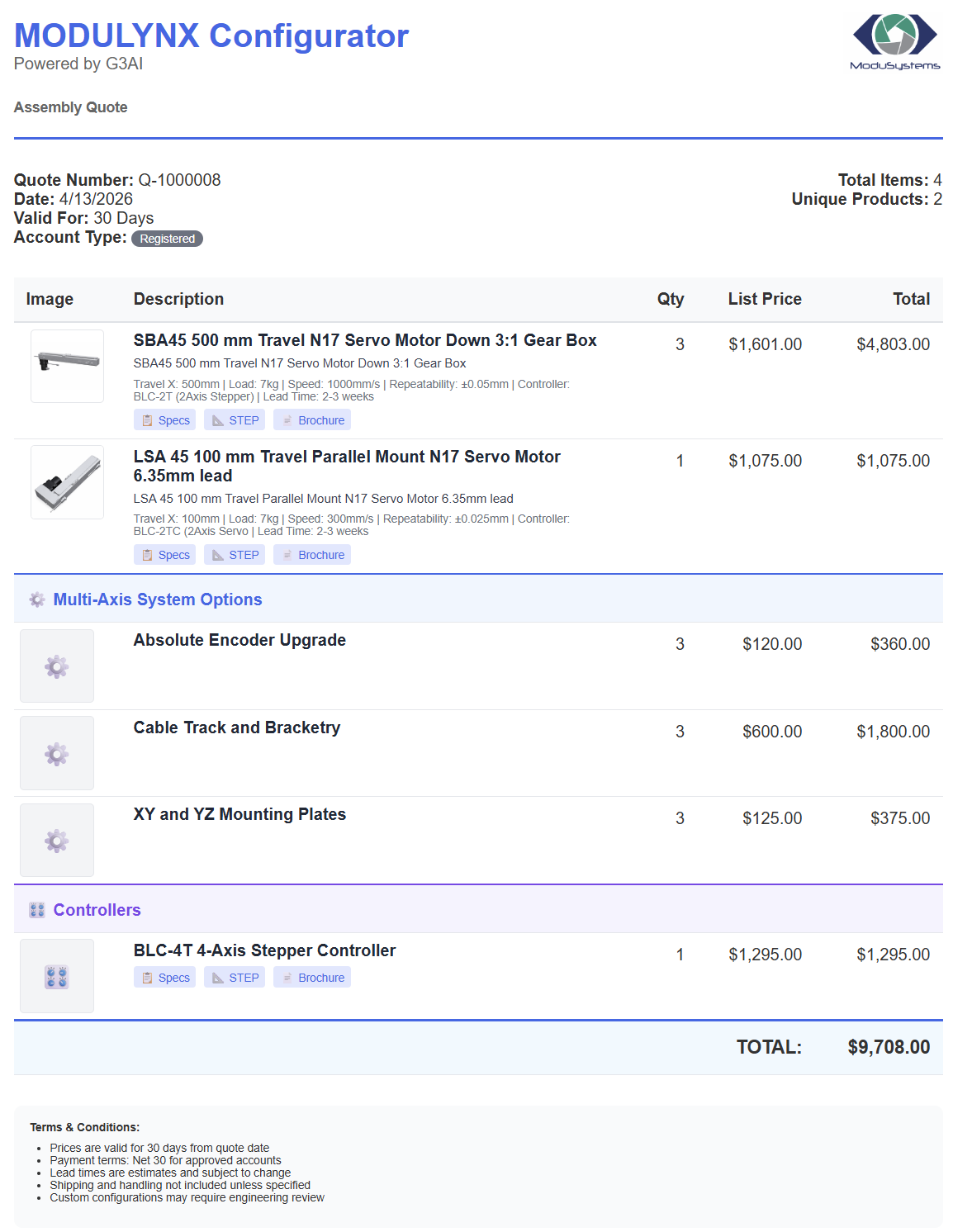
Generate a professional quote document with terms, lead times, and configuration IDs. Save quotes, share configurations, and track everything from your dashboard.
One click generates a complete quote document — branded header, quote number, itemized line items with product images, spec summaries, STEP and brochure links, multi-axis options, controller details, and totals.
Terms and conditions, lead times, and account type are all included. The document is ready to email, print, or feed into your approval workflow.
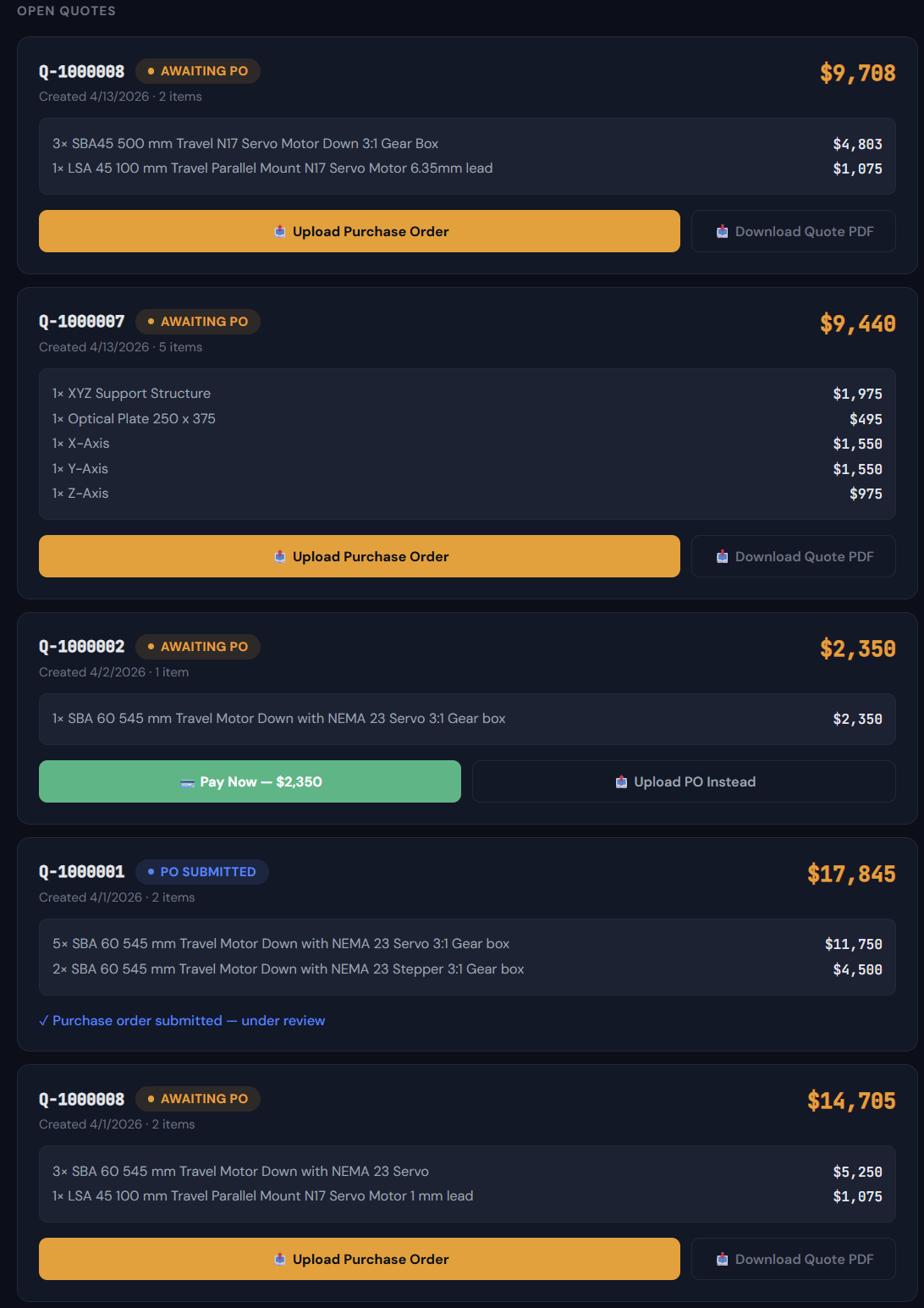
Every saved quote flows into a tracked order pipeline. Customers see their open quotes, upload purchase orders, pay directly, or download quote PDFs — all from a single dashboard.
On the manufacturer side, the admin panel tracks every quote, order, and registered user. Ready for ERP integration — order data is structured for direct feed into SAP, Oracle, or any fulfillment system.
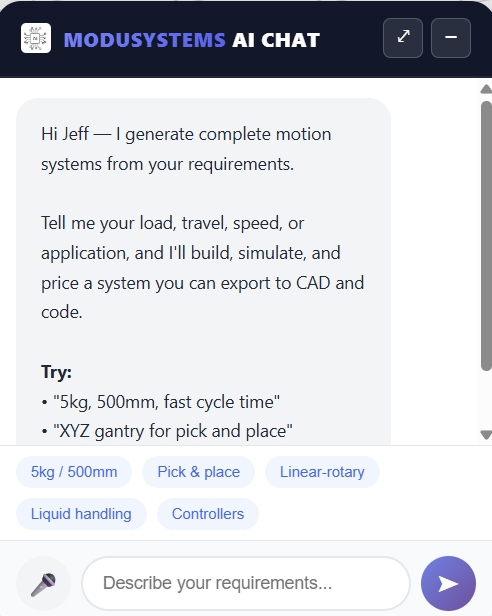
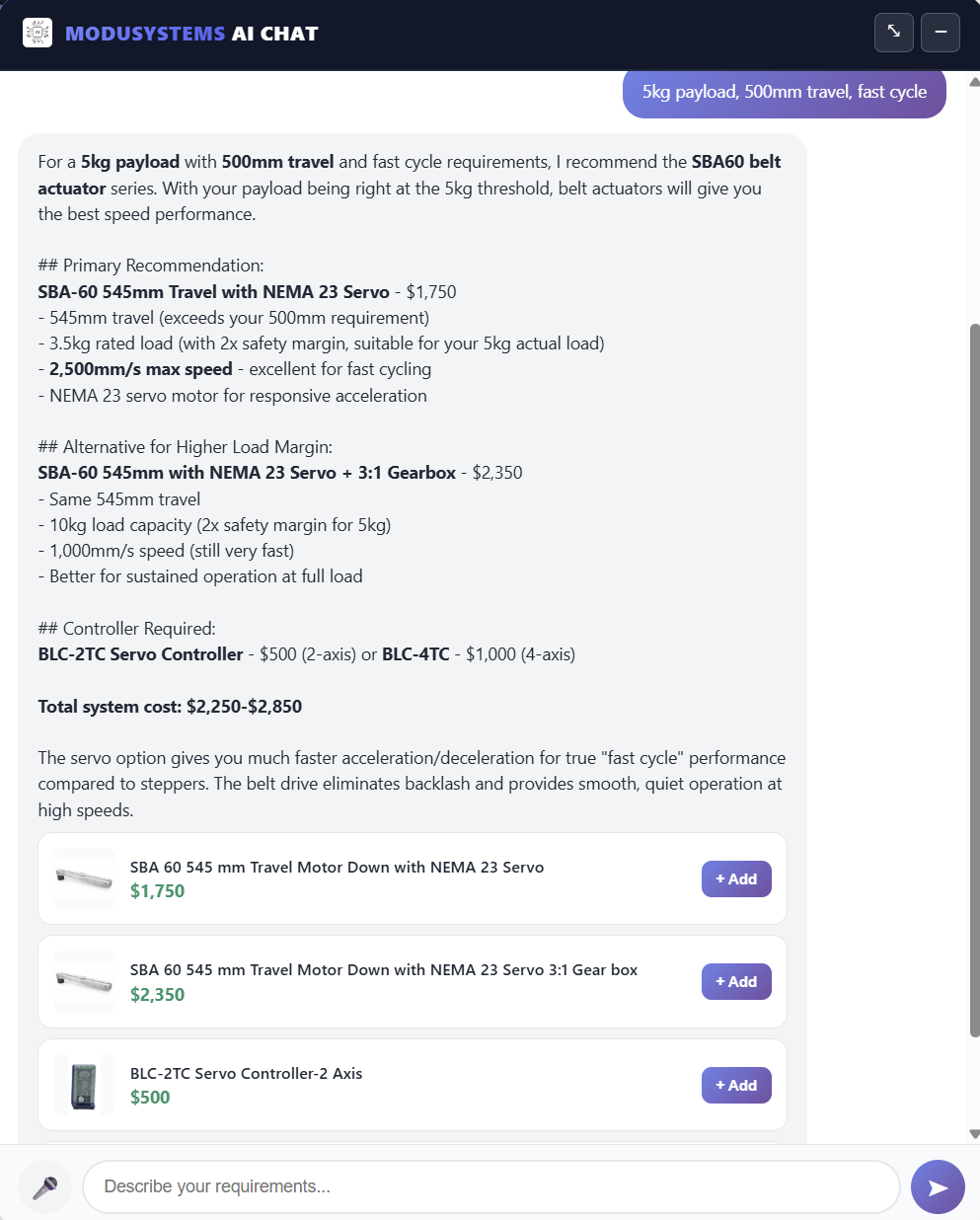
Talk to ModuSystems AI in plain English. Tell it your payload, travel, and cycle time — or paste an application description — and it returns a validated system recommendation with parts, prices, and a one-click Add to quote.
The chat understands the full ModuSystems catalog: LYNX actuators, AXYS controllers, gearboxes, motors, and accessories. It cross-checks specs against the engineering envelope, suggests alternatives when a constraint is borderline, and explains its reasoning so you can verify before quoting.
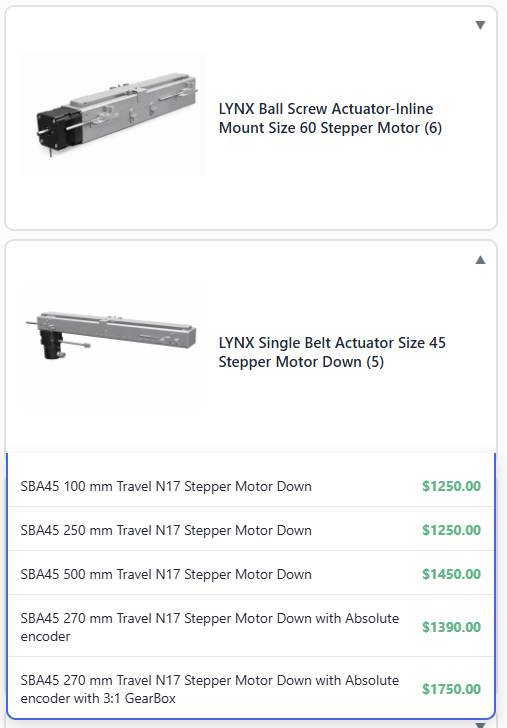
Every product in the library carries full parametric data — payload capacity, travel range, max speed, repeatability, encoder type, brake options, gearbox ratios, and mounting configurations. 200+ catalog SKUs across belt, lead-screw, ball-screw, linear-rotary and multi-axis families — and growing.
The catalog is designed to scale. Add your own products, define specs, upload 3D models, and set pricing tiers. OEMs and distributors can white-label the entire library or build their own alongside it — same engine, your brand.
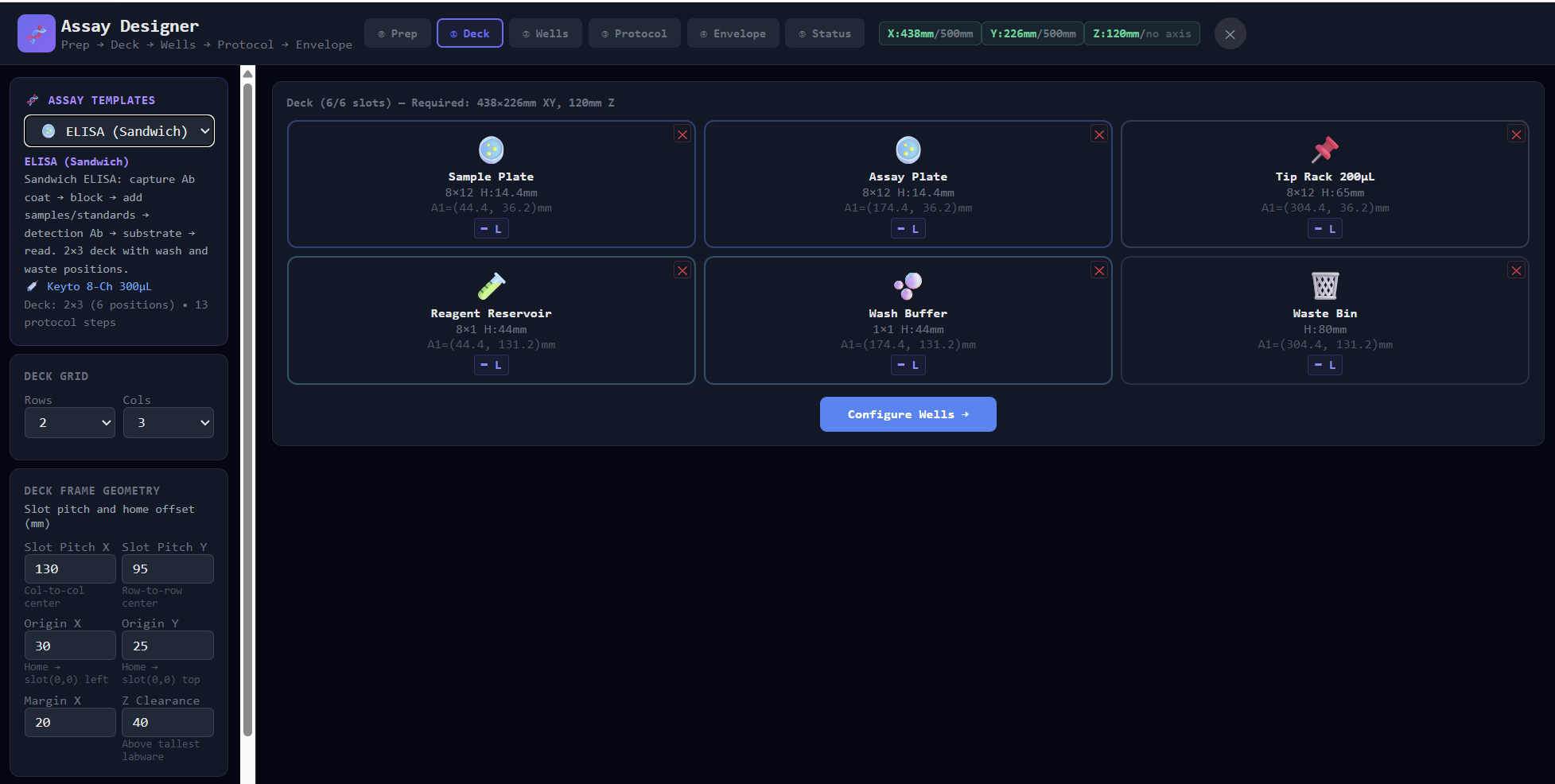
A full liquid handling protocol designer built into the platform. Five guided phases — Sample Prep, Deck Layout, Well Painting, Protocol Builder, and Envelope Check — take you from blank deck to validated, machine-ready protocol.
Define plates, reagents, and pipetting sequences visually. The AI validates volumes, checks dead zones, and generates optimized tip paths. Supports 96-well plate formats with coordinate-level control over Z-heights, aspirate/dispense speeds, and mixing cycles.
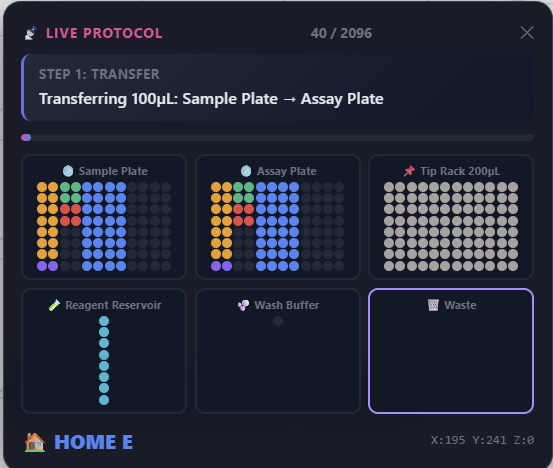
A real-time status dashboard that tracks every operation as it executes. Live deck view shows plate positions, tip state, and current operation. Full logging captures volumes, coordinates, timestamps, and errors.
Adjust speed mid-run, pause and resume protocols, and monitor axis positions across all channels. Designed for direct connection to BLC controllers — configure in the browser, stream to hardware.
Every capability an engineer, sales team, or distributor needs — integrated into a single platform.
Conversational assistant that understands motion engineering. Describe your application in plain language — it builds, compares, and explains.
STEP files for every component and the full assembly. GLB download for integration into external 3D environments.
Point your phone and place a configured system on your factory floor. Full scale, real lighting — see how it fits before you order.
Registration, authentication, and tiered access. Gated features for registered users. Admin panel for analytics and catalog management.
Structured order data ready for SAP, Oracle, NetSuite, or custom ERP feeds. Quote-to-order pipeline with no manual re-entry.
Share configurations via link. Record animations as video. Upload custom models. Every interaction tracked and recoverable.
Traditional motion system design takes days of spreadsheets, PDF catalogs, and back-and-forth with sales engineers. ModuSystems AI takes minutes.
Enter payload, travel, speed — or describe your application in plain language. The AI understands context like "pick and place" or "liquid handling."
ModuSystems AI selects actuators, sizes gearboxes, validates safety margins, and assembles a complete multi-axis system in real-time 3D.
Program motion sequences, run simulations, check cycle times, swap components. Every change recalculates instantly.
Get a priced BOM. Export STEP files and motion code. Generate a quote. Upload a PO. The full lifecycle in one platform.
ModuSystems AI runs on top of ModuSystems' real product catalog — the same modular motion hardware you'd order through a sales engineer, now with AI doing the engineering work first. Every actuator selected, every gearbox sized, every controller matched is grounded in production parts shipped from San Jose, California.
It sizes both from your payload, speed, and travel on real torque-curve data — stepper pull-out curves at 24 V, servo continuous curves at 48 V — and reports torque margin, speed margin, inertia mismatch, and throughput for each, with the price difference per axis. The smallest motor with at least 25% torque margin at speed wins.
No. A chatbot predicts the next word. The Engineering Decision Engine runs deterministic sizing math against a real product catalog and shows its work — every spec ships with the assumptions, safety gates, and calculations behind it, so your engineers can check it by hand.
Belt-driven SBA actuators from 100 mm to 1,275 mm travel in three frame sizes (NEMA 17, 23, 34); lead-screw LSA actuators for Z axes up to 15 kg; ball-screw BSA actuators to 500 mm. Payloads to 25 kg on stepper systems and 50 kg on servo. Longer travels and heavier payloads are handled as engineered systems — ask the engine and it will size the closest catalog option and quantify the gap.
Yes. Every part has a STEP file, and the motion program you build in the sequence editor exports as Python, G-code, or C++ for direct controller integration. The same program drives the 3D simulation and the digital twin.
You can design and size as a guest. A free account (name, email, company) saves your systems, generates a formal quote, and opens the order portal for purchase orders.
ModuSystems AI is live. Enter your requirements and build a motion system right now.
Launch ModuSystems AI →